Begin with the piece, not the method
The choice between printing and embroidery becomes easier when you stop treating either method as a universal quality label. A decorated garment has to work as a whole: fabric, fit, artwork, placement and the way someone uses it. The right question is what treatment serves this particular piece, at this size, for this order.
This guide provides a sample-led decision process rather than a fixed ranking. Production methods vary between decorators, and the same artwork may need different preparation on different products. Ask the supplier to explain its own limits and approve a physical result before committing the full order. A digital rendering can help you choose a direction, but it cannot tell you how the decorated area feels against the body.
Write a short use brief
Describe who will wear the garment and what they will do in it. A tee sold at an event may need a large illustration. A reception polo may need a small identifying mark. An outer layer may be worn over several other garments. Those uses create different priorities for visibility, surface feel and placement.
Include the expected care routine. Give the decorator the selected garment reference and ask for care instructions that apply to the finished piece. Avoid assuming that a method name alone predicts how the result will behave over time. If frequent laundering matters, include that use in the sample review and agree what the supplier can substantiate about the actual combination.
Inspect the artwork at its final size
Print the proposed mark on paper at the intended dimensions and place it against the garment. Look at the smallest text and the spaces between letters. Decide what must remain legible and what can be simplified. Enlarging the artwork on a screen can hide the fact that a detail will be tiny when it reaches a sleeve or chest position.
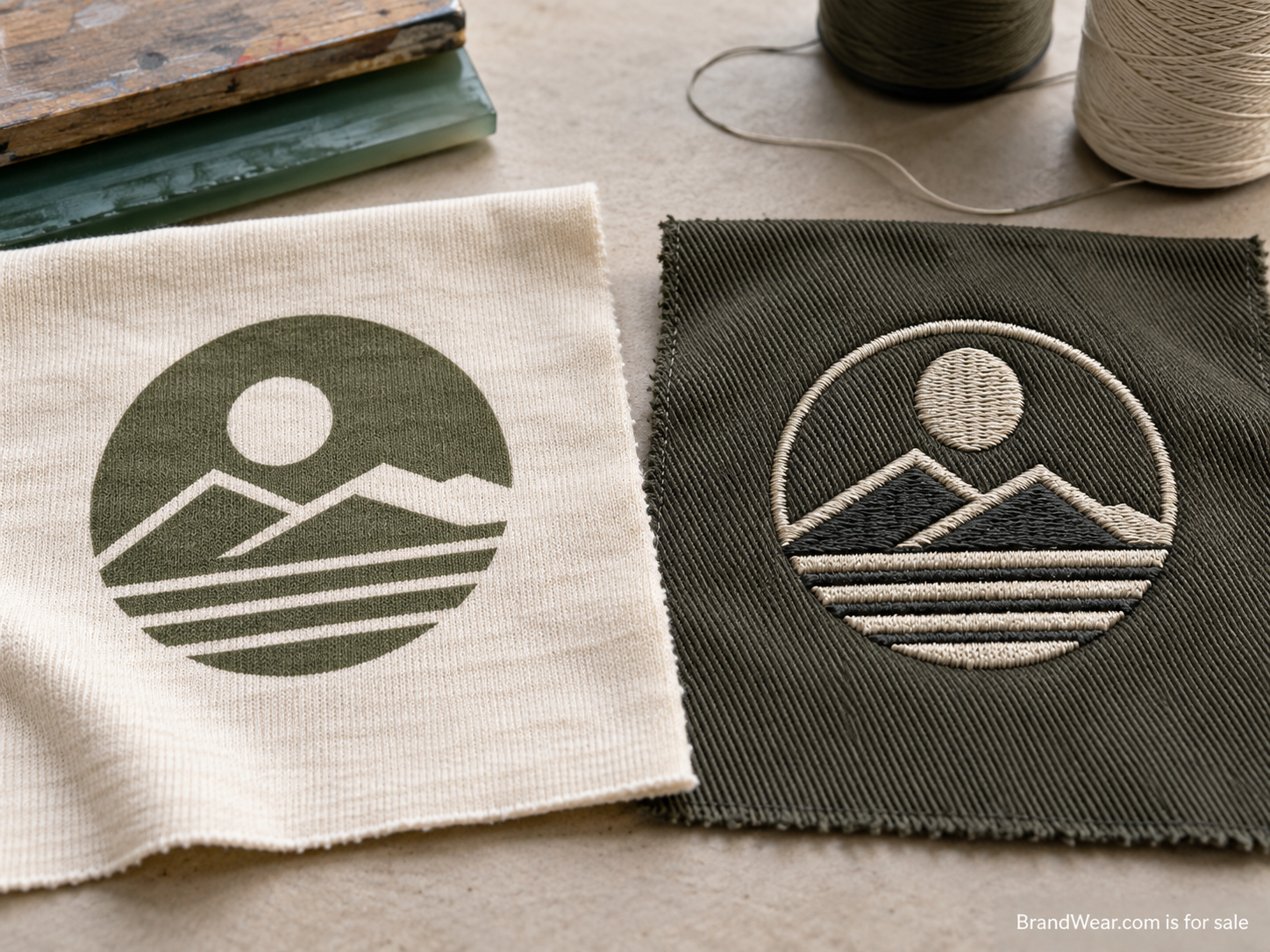
Embroidery translates artwork into stitches. Printful describes digitization as preparing a stitch file for its machines and notes that design changes may be needed to meet its guidelines. That is a reason to ask for an embroidery-specific proof, not merely send the same image used on the website. The chosen decorator should explain which details need to change and why.
Keep the brand owner involved when simplifying a logo. The production team should not independently remove a line, alter a letter or change the relationship between elements. Approve a garment version of the mark if one is needed, then keep it with the production specification so the same question does not return on every reorder.
Compare the feel on the actual fabric
Ask for the decoration on the selected blank. A loose fabric swatch is helpful, but a finished garment lets you assess the position during movement and see what happens near seams, pockets or a zip. Put it on, sit down, raise your arms and check whether the decorated area changes the way the piece hangs.
With embroidery, examine the reverse side as well as the face. Ask about the backing and whether it is appropriate for the chosen garment and placement. With a printed sample, examine coverage and feel across the decorated area. Compare the result with the purpose of the piece rather than assuming that a more noticeable treatment is automatically better.
The decision can be mixed across a collection. A studio might choose a small stitched mark for a structured layer and a printed illustration for a tee. There is no need to force one technique onto every item to make the range coherent. A consistent palette and sensible scale can connect pieces that use different production methods.
Make the print proposal specific
“Print” covers more than one production approach. Ask the supplier to name the proposed method and explain why it suits the fabric, artwork and quantity. Request the file requirements and any limitations that would affect the design. Keep the comparison tied to that proposal rather than comparing a specific embroidery sample with an undefined printing option.
For artwork preparation, use the product and placement instructions supplied by the decorator. Printful's print-file guidance identifies format, resolution, color profile and transparency as checks before upload. Those categories are useful questions for any production conversation, even though another supplier may use different specifications. Ask for the requirements in writing before preparing the final file.
Compare the whole order cost
Request a quote with setup, sampling, decoration and garment costs shown separately. Ask what changes when quantities, artwork size or locations change. A second decoration position is additional work, even if it uses the same logo. A revised stitch file or another sample may also affect the total. Make those assumptions visible before comparing proposals.
Do not decide from unit cost alone if the two offers cover different work. One may include a physical sample while another only includes a digital proof. One may assume a single artwork version across all sizes, while another accounts for a smaller placement on smaller garments. Align the scope, then compare the total commitment and the reorder terms.
Run a side-by-side sample review
Use a short review sheet with four headings: appearance, comfort, care and repeatability. Under appearance, note whether the essential details are clear at normal viewing distance. Under comfort, record what the wearer notices during ordinary movement. Under care, document the instructions and any sample checks agreed with the supplier. Under repeatability, ask which approved files and references will be retained.
Have more than one person try the sample when fit or placement affects different body sizes. Keep comments specific. “The back print feels too broad when sitting” gives the decorator something to discuss. “It does not feel premium” is a reaction, but it needs another question before it becomes an actionable change. Photograph the sample with a ruler where measured placement matters.
An illustrative collection decision
Consider a company preparing a tee and an overshirt for a customer event. The tee artwork includes a broad illustration and a short line of text. The overshirt needs only a small company mark. The buyer requests a printed tee sample and an embroidered overshirt sample, then reviews both on the selected blanks rather than asking one method to serve both designs.
The first overshirt proof loses a small detail in the mark. The brand owner approves a simplified garment version, and the decorator produces a revised sample. The tee's placement is moved after wearers find it sits too low. Those changes become part of the final specification. The decision is now supported by physical evidence, not a preference declared before sampling.
Leave a useful record for the reorder
Keep the approved garment reference, artwork version, finished dimensions, placement measurements and sample photographs together. Name the person who approved the result and the date. Ask the supplier what information would need checking if the blank, fabric color or production equipment changes. A previous approval is useful context, but it should not become permission for an unreviewed substitution.
For your next order, choose the method only after you can explain it in one practical sentence. The reason might be the artwork's scale, the feel of the sample or the way the mark sits on that garment. Save that sentence with the specification. It will help the next colleague understand the decision and recognize when a future change calls for another sample.